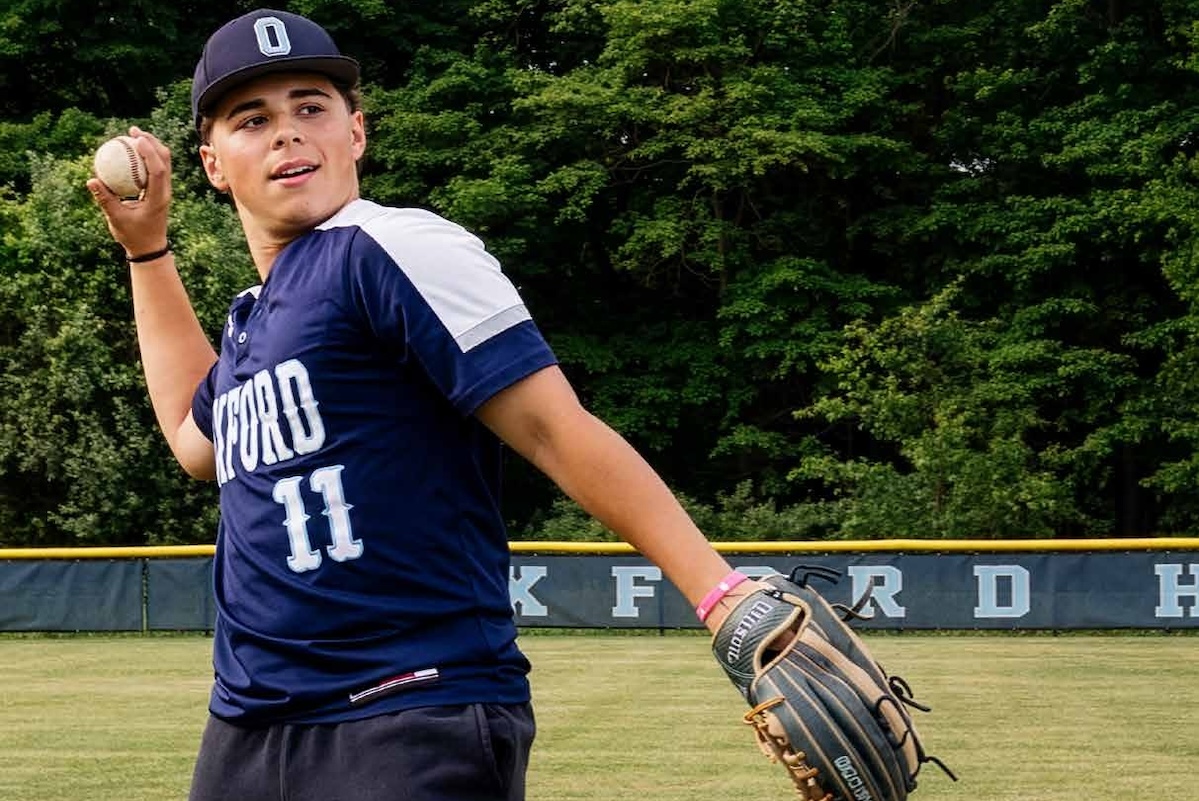
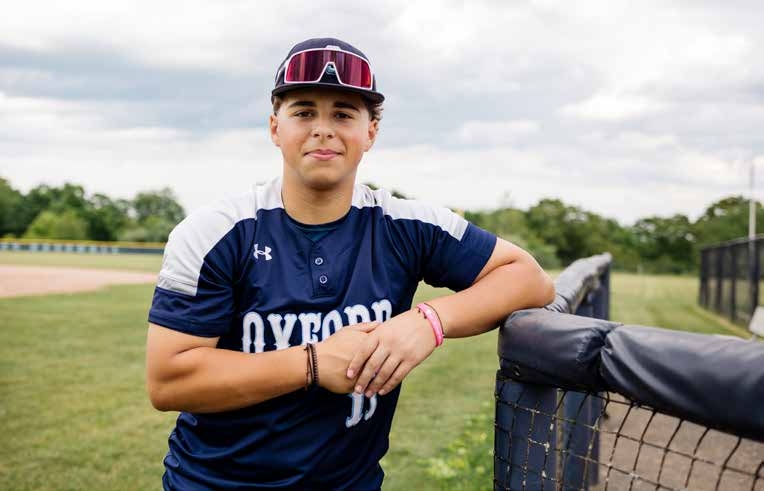
The batter hit a fly ball between left and center. Cole Cianflone—then 14 and playing left field for a travel baseball team from Connecticut—dove and made the catch. "I was just focused on the ball and not where my teammate was," he says. The same was true for the center fielder. The two boys violently collided. "His knee went full speed into my left side," Cole says. Cole tried to get to his knees, flipped the ball to second base, then collapsed.
The game, being played on July 19, 2025, in Piscataway against a team from Southeastern Pennsylvania, came to a halt. "Coach came out and asked if I was okay," Cole says. "I had pain like I'd never felt before in my life. I said, 'Dude, I don't know, I might need to be taken out.'"
Cole's father, Paul DiGiovanni, was watching from the sidelines as the coach waved him onto the field. "Kids collide all the time, and at first I thought Cole was just winded," Paul says. "But he had difficulty moving, had turned pale, and was covered in sweat."
An ambulance took Cole to The Bristol-Myers Squibb Children's Hospital (BMSCH) at Robert Wood Johnson University Hospital (RWJUH) in New Brunswick. He was rushed... ...into the Pediatric Trauma Center, one of only three Level I Trauma Centers in New Jersey. RWJUH is the only state-designated Level I Trauma Center to have an American College of Surgeons Committee on Trauma-verified Level I Pediatric Trauma Program.
Critical Decisions
"At one point," Cole remembers, "it seemed like there were about 20 doctors surrounding me. It all happened so quickly." The buzz of activity reflected urgent questions that needed to be answered fast. Tests and examinations found that Cole had not only four broken ribs but also a crushed spleen.
"His spleen injury was Grade 5—the most severe kind," says Sathyaprasad Burjonrappa, MD, a pediatric surgeon at BMSCH and a member of RWJBarnabas Health Medical Group. "The spleen was completely shattered."
Cole's injury was potentially life-threatening. Blood vessels engorge the spleen. "There's a danger that a patient with a shattered spleen will bleed out," Dr. Burjonrappa says. A long-standing approach to devastating spleen trauma has been to seal off blood flow to the organ or remove it altogether.
"Those options defunctionalize the spleen and are permanent," Dr. Burjonrappa says. "We offer them, but the goal is to save the spleen and fully preserve its function. The resources of a Level I Pediatric Trauma Center allow us to offer the highest level of care without surgery."
Preserving the spleen's function is especially important in children because it serves an important role in protecting the body against infections from capsulated bacteria such as those that cause pneumonia and meningitis.
Young people are more susceptible to immune-related complications, such as infection, if the spleen isn't functioning. Another factor in the decision: Children have a higher capacity to heal.
Dr. Burjonrappa compares Cole's shattered spleen to a smashed orange in which the skin is intact, but segments inside have detached and separated. "If you leave the spleen alone under close supervision, the segments can bind back together," he says. The question was what dominated Cole's injury—bleeding or healing.
Pediatric trauma experts monitored Cole continuously. "His blood pressure and heart rate were closely monitored, and he was kept on strict bed rest for 24 hours in addition to monitoring his blood counts," says Paul, who stayed with Cole in the pediatric intensive care unit—the state's largest, staffed by fellowship-trained pediatric intensivists. Cole's mother, Joy DiGiovanni, drove from Connecticut to be with her son and husband.
The Healing Begins
Cole received a blood transfusion, but it soon became clear that his spleen would mend with proper care. "He's a very tough kid," says Dr. Burjonrappa. "His recuperative capacity was so good that in three days he started healing."
"As a worried mom, you have a hundred questions," says Joy. "I didn't understand how a spleen could recover by itself after being injured that badly. I'm still amazed." But Dr. Burjonrappa kept assuring us it would be fine with the right care. The family went home after four days.
Cole found summer convalescence challenging. "I'm a very active person," he says. "But I listened to my body and didn't push myself too hard." By September, he could swing a bat. He slowly ramped up training and by spring 2026 had qualified as a freshman for his high school's baseball team.
"The first time fielding a fly ball was scary," Cole says. "I had to get my mind right and couldn't be fearful out there. Once I knew I was back to where I had been before the injury, nothing was stopping me."
To learn more about the Children's Health network at RWJBarnabas Health, visit rwjbh.org/childrenshealth.